Did you know that 70% of your child’s immune system exists in the gut?
Yup! It is home to trillions of microorganisms, or gut flora, that play a key role in developing a strong immune system.1 In other words, your child’s gut wall is lined with an army of immune cells. These immune cells play an important role to defend against invading germs that cause common childhood illnesses. In a healthy gut environment, the good gut bacteria and immune cells work together as the first line of defence to protect your child. A balanced gut helps children absorb nutrients from food, which is vital for proper growth and development.1
When a child’s gut health is neglected, it can lead to several problems. A poor balance of gut bacteria, also known as dysbiosis, may weaken their immune system, making them more vulnerable to illnesses.2 It can also cause digestive issues like bloating and constipation, and potentially affect their mood and mental well-being due to the close link between the gut and the brain.2,3,4

Is It True That C-Section Delivery Has An Impact On A Child’s Gut Health?
Along with other factors, based on studies, C-section delivery can disrupt a child’s gut microbiota, which may affect their immunity for the first five years of life.5 To help restore this balance, a combination of prebiotics and probiotics, known as synbiotic, can be beneficial. Additionally, healthy and balanced eating habits are essential to improve a child’s gut health and support their immune system.
Why A Healthy Gut is Important for Children
Now let’s dive further into why it is crucial that we, as parents, start focusing on our children’s gut health from day one.
- A Healthy Gut Supports a Healthy Immune System

It’s always a parent’s worst nightmare when a child gets sick. As children play outdoors, they are more likely to be exposed to and ingest disease-causing germs like bacteria and viruses. Hence, it’s especially important for children to have a strong and healthy immune system to ward off infections.
- Reduces Risk of Allergies

The first two years of life represent a critical window within which you can train a child’s immune system to mount an appropriate defence to disease-causing germs and dietary antigens (a.k.a bad stuff that triggers allergies). Successful navigation of these helps your child to develop a robust adaptive immune defence, building tolerance over time.
A healthy or balanced gut microbiota is a harmonious community of bacteria, viruses, and fungi, with no single microorganism dominating.1 This healthy gut is crucial for every child, as it plays a vital role in helping them grow strong and healthy while their immune system matures. So how do we help our little ones build a healthy gut?
One of the recommended ways is to nourish the gut with prebiotics and probiotics.1
Probiotics are beneficial gut bacteria that you can consume in supplements or fermented foods to help populate your gut.1 Meanwhile, prebiotics are dietary fibres that feed, or promote the growth of beneficial gut bacteria.1 Prebiotics such as galacto-oligosaccharides (GOS) and fructo-oligosaccharides (FOS) are non-digestible carbohydrates that nourish beneficial gut bacteria.6,7
A key probiotic strain that benefits from these prebiotics is Bifidobacterium breve M-16V, which is a Human Residential Bifidobacteria (HRB), meaning it is naturally suited to live in the human gut. B.breve M-16V is commonly found in the guts of healthy children and plays a crucial role in supporting a balanced gut microbiome and developing a strong immune system. When a child consumes prebiotics, it helps this vital probiotic thrive, leading to a balanced gut and better overall health, especially during the early stages of life.8
- Supports Brain Development

90% of a child’s brain develops by the age of 59 and the formation of brain connections is critical to early development. This impacts a child’s cognitive function, vision, language skills, and motor capabilities.
Proper nutrition is crucial for normal brain development. The gut has a central role to this process as it receives and absorbs all the needed nutrients for optimal and timely brain development.
And did you know that the good bacteria in a child’s gut also affects brain development and brain connections? Studies show that prebiotics GOS and FOS work together with probiotic B. breve to create a healthy gut environment that positively impacts brain function.10
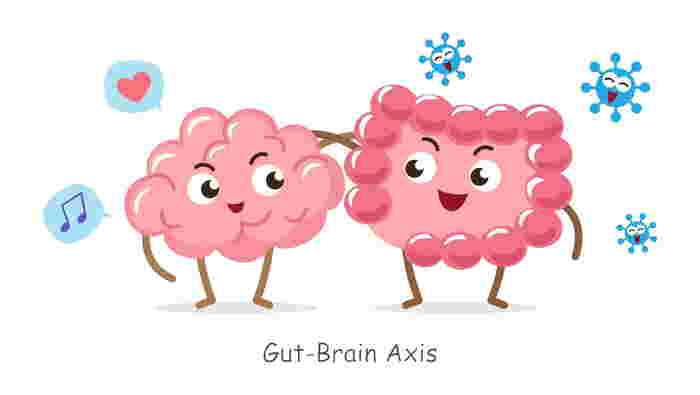
This connection is made through the gut-brain axis, a two-way communication system. How? Through the direct connection between the gut and the brain that is made up of a vast network of nerves, the most significant being the “vagus nerve”. It plays a significant role in how your brain influences gut functions (like digestion) and how your gut influences your mood and stress response.11
In addition to that, you can also support your child’s brain development and cognitive function by supplementing their daily diet with brain nutrients such as:
- Tryptophan: An essential amino acid that converts to serotonin, a crucial neurotransmitter. Serotonin is widely known for its role in regulating mood, sleep, appetite, and social behavior.12
- Sphingomyelin: A type of fatty lipid that is a key component of the myelin sheath – a protective coating around nerve fibers (axons) in the brain.13
- Omega-3, 6 and 9 fatty acids and DHA: Essential building blocks for the brain.14
- Vitamin B12: Vital for maintaining healthy nerve cells and producing red blood cells that carry oxygen to the brain, supporting overall brain function.15
So, remember, a happy gut feeds a happy brain!
Now that you know just how important your child’s gut health is, you’d want to know how you can better support it. Feeding your child with the right nutrients at the right time is an important step to ensuring a happy and healthy gut. Given that a significant amount of your child’s nutrition in the early years comes from milk, it is a good idea to select a formula that is packed with a good blend of prebiotics and probiotics for immunity support and essential brain nutrients for brain development.
References:
- Cleveland Clinic. (n.d.). Gut microbiome. Cleveland Clinic. Retrieved August 31, 2025, from Cleveland Clinic website: https://my.clevelandclinic.org/health/body/25201-gut-microbiome
- Cleveland Clinic. (n.d.). Dysbiosis: What it is, symptoms, causes, treatment & diet. Cleveland Clinic. Retrieved August 31, 2025, from https://my.clevelandclinic.org/health/diseases/dysbiosis
- Bankole, T., & Li, Y. (2025, May 29). The early-life gut microbiome in common pediatric diseases: Roles and therapeutic implications. Frontiers in Nutrition, 12 (Section: Nutrition and Microbes). https://doi.org/10.3389/fnut.2025.1597206
- Guts UK. (2024, July). What is the gut-brain connection activity? Guts UK. Retrieved August 31, 2025, from https://gutscharity.org.uk/2024/07/what-is-the-gut-brain-connection-activity/
- Roswall, J., Olsson, L. M., Kovatcheva-Datchary, P., Nilsson, S., Tremaroli, V., Simon, M.-C., Kiilerich, P., Akrami, R., Krämer, M., Uhlén, M., Gummesson, A., Kristiansen, K., Dahlgren, J., & Bäckhed, F. (2021, May 12). Developmental trajectory of the healthy human gut microbiota during the first 5 years of life. Cell Host & Microbe, 29(5), 765–776.e3. https://doi.org/10.1016/j.chom.2021.02.021
- Obayomi, O. V., Olaniran, A. F., & Owa, S. O. (2024, July 6). Unveiling the role of functional foods with emphasis on prebiotics and probiotics in human health: A review. Journal of Functional Foods. Advance online publication. doi.org/10.1016/j.jff.2024.106337S1756464624003396#:~:text=They%20support%20a%20healthy%20gut,Oz%20&%20Kafkas%2C%202017
- Davani-Davari, D., Negahdaripour, M., Karimzadeh, I., Seifan, M., Mohkam, M., Masoumi, S. J., Berenjian, A., & Ghasemi, Y. (2019, March 9). Prebiotics: Definition, types, sources, mechanisms, and clinical applications. Foods, 8(3), 92. doi.org/10.3390/foods8030092; PMC 6463098
- Wong, C. B., Iwabuchi, N., & Xiao, J.-z. (2019). Exploring the science behind Bifidobacterium breve M-16V in infant health. Nutrients, 11(8), 1724. doi.org/10.3390/nu11081724
- National Health Service. (n.d.). Early learning and development. Retrieved August 31, 2025, from NHS Start for Life website: https://www.nhs.uk/start-for-life/early-learning-development
- Ansari, F., Neshat, M., Pourjafar, H., Jafari, S. M., Alian Samakkhah, S., & Mirzakhani, E. (2023, July 26). The role of probiotics and prebiotics in modulating of the gut-brain axis. Frontiers in Nutrition, 10, Article 1173660. https://doi.org/10.3389/fnut.2023.1173660
- Cleveland Clinic. (n.d.). Vagus nerve: What it is, function, location & conditions. Cleveland Clinic. Retrieved August 31, 2025, from https://my.clevelandclinic.org/health/body/22279-vagus-nerve
- Cleveland Clinic. (n.d.). Serotonin: What is it, function & levels. Cleveland Clinic. Retrieved August 31, 2025, from https://my.clevelandclinic.org/health/articles/22572-serotonin
- Schneider, N., Hauser, J., Oliveira, M., Cazaubon, E., Colombo Mottaz, S., O’Neill, B. V., Steiner, P., & Deoni, S. C. L. (2019, August 5). Sphingomyelin in brain and cognitive development: Preliminary data. eNeuro, 6(4), ENEURO.0421-18.2019. https://doi.org/10.1523/ENEURO.0421-18.2019
- BrainMD. (2020, March 3). What are the differences and benefits of omega-3, 6 & 9? BrainMD. Retrieved August 31, 2025, from https://brainmd.com/blog/guide-to-omega-3-6-9-supplements/
- Berkheiser, K. (2024, January 30). Health benefits of vitamin B12, based on science. Healthline. Retrieved August 31, 2025, from https://www.healthline.com/nutrition/vitamin-b12-benefits
Ada isu keibubapaan yang buat anda risau? Jom baca artikel atau tanya dan dapat terus jawapan dalam app theAsianparent kami! Download theAsianparent Community di iOS dan Android sekarang!


 Menjadi ibu bapa
 Anak
Anak Keibubapaan
 Kesihatan
 Penyusuan & Pemakanan
 Pendidikan
 Gaya Hidup
 TAP Cadangan
 #PendidikanKewangan
 Beli-Belah
 VIP
VIP Beriklan Dengan Kami
 Komuniti
 Ganjaran
 VIP Parents
